

Understanding Small Estate Affidavits and the Consequences of Dishonesty
A small estate affidavit is a legal document that allows heirs to transfer property without going through the full probate process when an estate’s value falls below a certain threshold. This simplified procedure can save time and money, but only when used honestly and correctly.
Quick Facts About Small Estate Affidavits:
- Used to transfer assets without formal probate proceedings
- Each state has different value limits (typically $15,000-$184,500)
- Requires waiting periods after death (usually 30-60 days)
- Available only for estates below statutory thresholds
- Signing under penalty of perjury
- Cannot typically be used for real estate (with some exceptions)
When someone submits a small estate affidavit, they’re making sworn statements about the deceased person’s assets, debts, and heirs. Providing false information isn’t just unethical—it’s illegal and can lead to serious consequences.
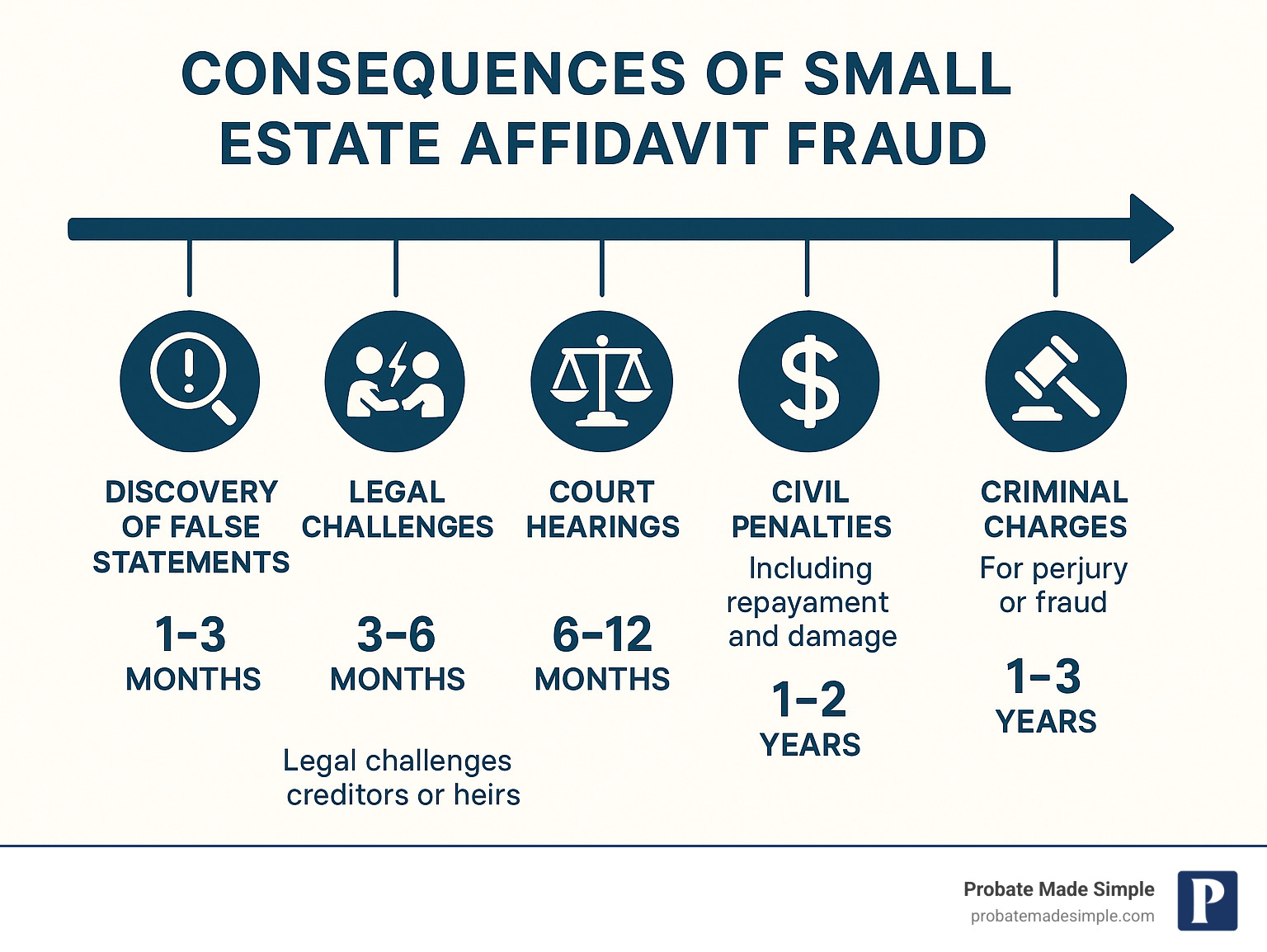
The affidavit process relies on honesty. When someone deliberately misrepresents information—whether by undervaluing assets, hiding debts, or misidentifying heirs—they’re committing fraud. These aren’t mere “mistakes” but potentially criminal acts that can result in civil penalties, criminal charges, and damage to family relationships.
I’m Paul E. Deloughery, founder of Probate Made Simple, and I’ve helped hundreds of families steer the complexities of small estate affidavits while ensuring legal compliance throughout the process. My experience with small estate affidavit cases has shown that understanding the serious consequences of misrepresentation is crucial for anyone considering this probate alternative.
Simple guide to small estate affidavit terms:
What Is a Small Estate Affidavit?
A small estate affidavit is your ticket to a simpler way of handling a loved one’s estate after they pass away. Think of it as a probate shortcut—a legal document that lets you collect and distribute a deceased person’s property without getting caught in the lengthy, often expensive formal probate process.
Here in Arizona, you can use a small estate affidavit when your situation meets these requirements:
The estate’s personal property (things like bank accounts, vehicles, and household items) doesn’t exceed $75,000 after subtracting any debts or liens. For real property (homes or land), the value limit is higher at $100,000 after deducting mortgages and other liens. You’ll also need to wait at least 30 days after your loved one has passed before filing, and there can’t be any pending applications for a personal representative.
The beauty of this process is its simplicity. It saves you time, money, and emotional energy during an already difficult period. But this streamlined approach comes with an important responsibility—complete honesty.
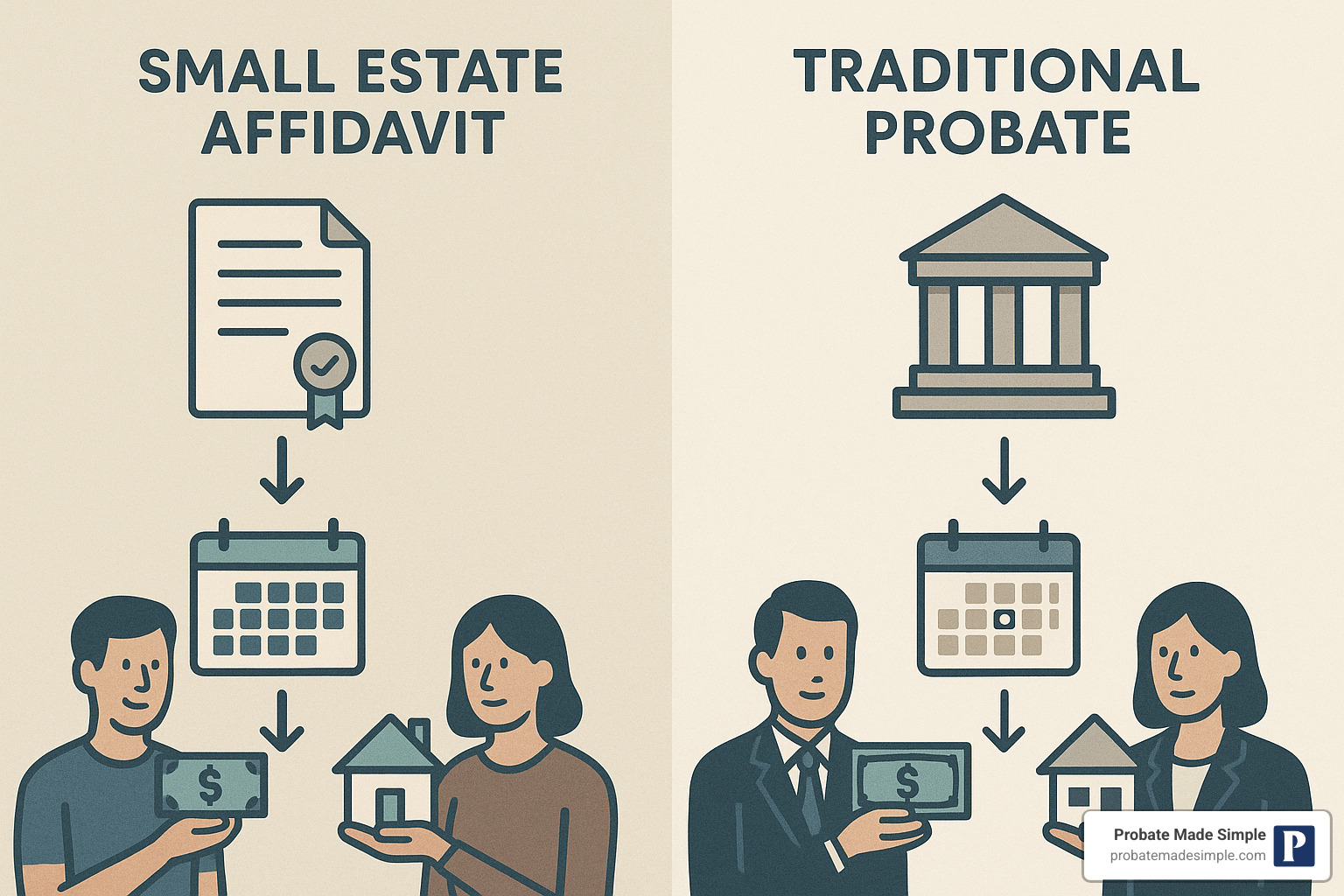
The difference between doing things right and wrong is stark:
| Truthful Small Estate Affidavit | Fraudulent Small Estate Affidavit |
|---|---|
| Lists all assets accurately | Undervalues or omits assets |
| Discloses all known debts | Hides or minimizes debts |
| Identifies all legal heirs | Omits legitimate heirs |
| Complies with state value limits | Falsely claims to be under limits |
| Provides accurate documentation | Includes forged or altered documents |
| Results in proper distribution | Results in improper distribution |
| Legal protection for affiant | Legal liability and potential criminal charges |
Key Eligibility Rules for a small estate affidavit
To use a small estate affidavit in Arizona, you need to meet several specific requirements:
The value caps are non-negotiable—personal property must be under $200,000 and real property under $300,000 (minus any debts or liens). Even being just a few dollars over these limits disqualifies you from using this simplified process.
The waiting period is at least 30 days after death before filing. This gives everyone a chance to gather information about assets and potential claims against the estate. In some cases, you might need to wait 45 days, depending on the specific circumstances.
You must qualify as a successor under Arizona law. This typically means you’re the surviving spouse, a child of the deceased, another heir entitled to inherit under intestacy laws, a beneficiary named in their will, or a trustee of a trust that benefits from the estate.
Lastly, there can’t be any pending petition for a personal representative in any jurisdiction. If someone has already started the formal probate process, the simplified affidavit route is off the table.
Misrepresenting any of these requirements isn’t just bending the rules—it’s making a false statement under oath, which has serious consequences.
Property That Can & Cannot Be Transferred with a small estate affidavit
Understanding what property can and cannot be transferred using this simplified process helps prevent unintentional fraud.
You can typically transfer bank accounts and cash, stocks and securities, vehicles (though there are specific DMV procedures to follow), personal belongings, unpaid wages owed to the deceased, refunds or rebates, and even small business interests if they’re within the value limits.
However, you cannot typically transfer real property that exceeds the statutory limit, property already held in a trust (this follows different rules), assets with designated beneficiaries like life insurance policies or retirement accounts, jointly owned property with right of survivorship (which passes automatically), or assets involved in ongoing litigation.
Arizona is actually more flexible than many states when it comes to real property. Here, you can transfer real estate using a small estate affidavit if its value (minus any mortgages or liens) doesn’t exceed $100,000 and you meet additional specific requirements. Many other states don’t allow real property transfers via affidavit at all.
Attempting to transfer property that doesn’t qualify for this simplified process isn’t just a mistake—it’s a form of misrepresentation that could lead to fraud charges, even if the total estate value falls within the limits.
Common Misrepresentations—and How They Solve
Let’s face it—when people fib on small estate affidavits, they’re usually trying to find a quick fix to a problem. Unfortunately, these “solutions” are actually illegal shortcuts that create much bigger headaches down the road.
1. False Asset Values
When someone finds the estate exceeds Arizona’s $75,000 personal property limit, some folks get creative with their math. Instead of following proper legal channels, they might drastically undervalue assets or conveniently “forget” to list certain items.
I once worked with a family where a deceased relative owned a beautiful classic car worth $40,000, had $45,000 in the bank, and personal belongings valued around $10,000. The total—$95,000—clearly exceeded Arizona’s limit. Rather than pursuing proper probate, a family member listed the car at just $25,000 on the affidavit, artificially bringing the estate under the threshold. This isn’t clever accounting—it’s perjury.
2. Hidden Debts
Nobody likes paying bills, especially someone else’s. When faced with a deceased loved one’s debts, some affiants simply pretend those obligations don’t exist.
For example, a client’s brother-in-law omitted $30,000 in medical bills and credit card debt from his mother’s small estate affidavit. His thinking was simple—what creditors don’t know about, they can’t collect. But creditors have ways of finding these omissions, and the legal fallout can be severe.
3. Forged Heir Signatures
Family disagreements about inheritance can lead to desperate measures. Rather than working through conflicts, some people resort to forging signatures or falsely claiming they have everyone’s consent.
In a particularly troubling case, the oldest of three siblings forged his brothers’ signatures on a small estate affidavit to gain control of their parent’s assets. When the forgery was finded, it not only triggered legal consequences but shattered family relationships that may never heal.
4. False Statements About Estate Administration
Some people file a small estate affidavit knowing full well that a probate case has already been opened elsewhere. This creates conflicting legal proceedings and can result in significant penalties.
I’ve seen cases where someone rushes to file an affidavit after learning another heir has already initiated formal probate in another county. This isn’t just ineffective—it’s deliberately misleading the court.

Each of these misrepresentations is considered perjury—you’re making false statements under oath. The temporary “fix” these falsehoods provide often leads to much more serious problems, including criminal charges and civil liability.
For legitimate ways to handle challenging estate situations, I recommend visiting our Estate Administration page where we outline proper procedures that won’t land you in hot water.
Red Flags Institutions Watch For in a small estate affidavit
Banks, the DMV, and other organizations that process small estate affidavits have become increasingly savvy about spotting potential fraud. They’re trained to look for several warning signs:
Financial institutions get particularly suspicious when they see death certificates that appear altered, asset values that conveniently total just under statutory limits, or forms missing proper notarization. They also pay attention to accounts with large withdrawals shortly before death, which might indicate someone was already helping themselves to assets.
Multiple versions of the same affidavit with different information is another major red flag, as is unusual urgency to process paperwork. Vague heir information or questionable relationship claims will also trigger closer scrutiny.
Many people don’t realize that institutions often communicate with each other about suspicious filings. That small estate affidavit you submitted to three different banks? If one spots a problem, the others may soon be alerted.
Real-World Arizona Examples of Affidavit Fraud
In my years of practice, I’ve seen some troubling cases of small estate affidavit fraud. While protecting client confidentiality, I can share some anonymized examples that illustrate the serious consequences:
In one heartbreaking case, a person claimed to be the deceased’s only surviving child on a small estate affidavit. After assets were distributed, two other children finded what had happened and filed a complaint. The court ordered full restitution plus attorney fees, and the county attorney pursued criminal charges for perjury. What might have started as greed ended with potential jail time.
Another common scenario involves Medicaid recovery evasion. A client’s relative filed a small estate affidavit that conveniently “forgot” to mention the deceased had received Medicaid benefits. When Arizona’s Medicaid program (AHCCCS) finded this omission, they sued the affiant personally for the full amount of benefits paid, plus substantial penalties.
Vehicle fraud is also surprisingly common. In one case, a nephew used a small estate affidavit to transfer title to his uncle’s collector vehicles, claiming they were worth just $15,000 total when their actual value exceeded $75,000. (That was the applicable limit at the time.) After quickly selling the vehicles, other family members finded the deception and reported it. The nephew faced both civil liability to the rightful heirs and criminal charges for filing false documents with the Arizona MVD.
These real-life examples show that Arizona courts and law enforcement take small estate affidavit fraud very seriously. The consequences go far beyond simply returning what was wrongfully taken—they can include criminal prosecution, financial penalties, and permanent damage to family relationships.
Civil & Criminal Penalties for Lying on a Small Estate Affidavit
When someone lies on a small estate affidavit, they’re not just bending the rules—they’re breaking the law. The consequences can be life-altering, affecting everything from your finances to your freedom.
Criminal Penalties
The criminal justice system takes small estate affidavit fraud very seriously. Since you’re signing under oath, false statements aren’t just dishonest—they’re criminal.
In Arizona, perjury isn’t a slap on the wrist—it’s a Class 4 felony that could land you behind bars for up to 3.75 years, even as a first-time offender. Think about that: nearly four years of your life gone because you tried to cut corners.
Depending on the value of what you’ve wrongfully claimed, you might also face fraud charges ranging from a Class 1 misdemeanor to a Class 2 felony. And if you’ve actually taken property that wasn’t rightfully yours? Add theft charges to the mix.
Perhaps worst of all is the permanent criminal record that follows you long after any sentence ends. Job applications, housing applications, loan applications—that felony conviction will haunt you for decades.
Civil Penalties
The civil consequences hit where it really hurts—your wallet.
First, you’ll need to return everything you wrongfully obtained, plus interest. But that’s just the beginning. In cases of intentional fraud, Arizona courts can award treble damages—that’s three times the actual amount taken. Took $50,000 wrongfully? You could be ordered to pay back $150,000.
The financial bleeding doesn’t stop there. You’ll likely be responsible for all attorney fees and court costs for the parties you’ve harmed. Add to that additional court-imposed surcharges, and the financial toll quickly becomes overwhelming.

If you’re considering filing a small estate affidavit in Arizona, please do it right. The Small Estate Affidavit – AZCourtHelp website provides official forms and guidance to help you steer the process legally.
How Creditors & Heirs Can Sue
When someone finds they’ve been victimized by a fraudulent small estate affidavit, they have powerful legal tools at their disposal.
Rightful heirs or creditors can file for rescission, essentially asking the court to cancel all transfers made under the fraudulent document. They can pursue claims for unjust enrichment, arguing that you’ve benefited at their expense without legal justification.
Conversion claims—the civil equivalent of theft—are common in these cases. And if you filed the affidavit claiming to act on behalf of the estate, you’ve likely breached fiduciary duties to other heirs and creditors, opening another avenue for liability.
Courts may also impose a constructive trust, requiring you to hold the property for its rightful owners until it can be properly distributed.
Don’t think you’re safe just because time has passed. In Arizona, fraud victims typically have three years from when they find the fraud to file claims—not from when you committed it. That means your deception could come back to haunt you years later.
Government Enforcement Actions
Private lawsuits aren’t your only worry. Government agencies have their own interest in maintaining the integrity of the small estate affidavit process.
Your local county attorney’s office may pursue criminal charges independently. The Arizona Attorney General’s fraud unit might get involved, especially in cases involving substantial assets or particularly egregious conduct.
If your fraud had tax implications—perhaps you failed to report income or assets—expect the IRS to come knocking with penalties and interest that make the original tax burden look tiny by comparison.
The Arizona Motor Vehicle Division aggressively investigates fraudulent vehicle transfers and can impose their own administrative penalties. And if you’ve hidden assets to avoid Arizona’s Medicaid program (AHCCCS) recovery efforts, they have specialized teams dedicated to pursuing those funds.
The truly frightening part? All these entities can pursue you simultaneously. One fraudulent affidavit could trigger a cascade of legal nightmares from multiple directions.
At Probate Made Simple, we’ve seen the devastating consequences of small estate affidavit fraud firsthand. The temporary gain is never worth the lasting pain. If you’re facing probate challenges, there are legitimate solutions available—ones that won’t put your freedom, finances, and future at risk.
Preventing and Addressing Affidavit Fraud
When it comes to small estate affidavits, an ounce of prevention truly is worth a pound of cure. I’ve seen too many families face heartbreaking consequences from affidavit mistakes that could have been avoided with proper preparation.
Prevention Strategies
The best way to avoid the serious penalties we’ve discussed is to approach the small estate affidavit process with honesty and thoroughness from the start. Before filing, take time to conduct proper due diligence by researching all assets, debts, and potential heirs. This isn’t just about legal compliance—it’s about honoring your loved one’s legacy with integrity.
When asset values are approaching the statutory limits in Arizona, don’t guess or estimate. Professional valuations from certified appraisers provide documentation that protects you from accusations of deliberate undervaluing. These independent assessments create a paper trail showing your good-faith effort to comply with the law.
Even though Arizona doesn’t always require notarization for every document, having your small estate affidavit notarized adds an important layer of verification. A notary serves as an impartial witness to your signature, making it harder for anyone to claim the document was forged or signed under duress.
Clear communication with all potential heirs is perhaps the most overlooked prevention strategy. By informing everyone who might have an interest in the estate and providing copies of the affidavit before filing, you create transparency that discourages later challenges. When heirs feel included in the process, they’re less likely to suspect fraud or file objections.
If you’re uncertain about any aspect of the affidavit, investing in a legal review before submission can save tremendous headache down the road. At Probate Made Simple, we often help clients review their affidavits to ensure compliance before they’re submitted.
For additional protection, consider providing indemnification or obtaining a bond to protect against unforeseen claims. Our Probate Court Filing service can guide you through these extra safeguards.
Steps to Correct or Contest a small estate affidavit
We’re all human, and mistakes happen. If you find you’ve made an unintentional error on an affidavit you’ve filed, don’t panic—but do act quickly. Contact any institutions or individuals who received the affidavit and inform them of the error immediately. Then prepare and submit a corrected affidavit, clearly noting what’s been fixed.
Document everything during this correction process. Keep copies of all communications and maintain detailed records of the steps you’ve taken. This documentation demonstrates your commitment to rectifying the situation promptly and honestly.

On the other hand, if you believe someone else has filed a fraudulent small estate affidavit affecting your rights, you need to take prompt action to protect yourself. Begin by filing a formal written objection with the court in the county where the affidavit was filed. Request a complete accounting of all assets collected and distributed under the affidavit, and petition the court to set aside (invalidate) the affidavit and any transfers made under it.
While pursuing these remedies, gather solid evidence showing the correct asset values, debt information, or heir relationships that contradict the fraudulent affidavit. In cases of clear, intentional fraud, don’t hesitate to report the matter to the county attorney’s office.
Alternative Paths When the Estate Exceeds Limits
Sometimes families find that an estate’s value genuinely exceeds Arizona’s small estate affidavit limits. When this happens, there’s no need to misrepresent values—several legitimate alternatives exist.
For estates slightly above the threshold, Arizona offers a summary probate procedure that’s still less complex than full formal probate but properly handles larger estates. For more substantial estates, formal probate provides a structured, court-supervised process that, while more time-consuming, ensures proper distribution of assets and payment of debts.
If your loved one established a living trust during their lifetime, trust administration offers another path for distributing assets outside of probate according to the trust terms. Many families don’t realize how many assets pass outside probate regardless of estate size, including life insurance with named beneficiaries, retirement accounts with designated beneficiaries, jointly-held property with right of survivorship, and payable-on-death accounts.
These legitimate alternatives remove any temptation to misrepresent estate values on a small estate affidavit. At Probate Made Simple, we help families identify the most appropriate option for their specific situation, ensuring they honor their loved one’s legacy while staying firmly within the law.
Cutting corners with a small estate affidavit might seem expedient in the moment, but the potential consequences—both legal and personal—simply aren’t worth the risk.
Frequently Asked Questions about Small Estate Affidavit Fraud
What if a bank refuses my affidavit because they suspect fraud?
It can be frustrating when a bank won’t accept your small estate affidavit, but remember—they’re just doing their job to prevent fraud. If this happens to you, don’t panic!
First, politely ask what specific concerns they have. Is it missing documentation? Inconsistent information? Understanding their exact concerns will help you address them effectively.
Next, gather any additional documentation that might help your case. This could include professional appraisals of assets, a certified death certificate, or clear proof of your relationship to the deceased. Sometimes simply providing more context resolves the issue.
If you’ve provided everything and still face resistance, you might consider having an attorney write a letter explaining how your affidavit complies with Arizona law. This often carries more weight than your explanations alone.
As a last resort, you can file a petition with the probate court to compel the institution to release the assets—but honestly, it rarely comes to this. Most institutions are reasonable once their concerns are addressed.
Banks have legal protections when they act in good faith to prevent fraud. Their caution, while inconvenient, helps protect everyone from fraudulent claims.
Can a will override misinformation in a small estate affidavit?
A valid will doesn’t automatically trump a small estate affidavit, but it’s powerful evidence when challenging potential fraud. Here’s the reality:
In Arizona, using a small estate affidavit doesn’t mean you can ignore a will. In fact, the affidavit must distribute assets according to the will’s terms if one exists. When someone files an affidavit claiming there’s no will when one actually exists, that’s a clear misrepresentation that courts take seriously.
If you find that someone has filed an affidavit that contradicts a valid will, you can use that will as evidence to contest the affidavit. The probate court has the authority to enforce the will’s terms even after assets have been distributed through an affidavit.
The smartest approach? Always attach a copy of any known will to your small estate affidavit. This transparency ensures you’re honoring the deceased’s wishes and protects you from accusations of concealing important documents.
Who is liable if hidden debts surface after distribution?
This scenario happens more often than you might think—assets get distributed through a small estate affidavit, and then suddenly a creditor appears with a legitimate claim. So who’s on the hook?
First and foremost, the person who signed the affidavit (that’s the affiant) becomes personally liable for valid debts up to the value of the assets they collected and distributed. This is why it’s so important to do your homework before signing anything!
The recipients who received distributions may also need to return assets (or their value) to pay legitimate creditors, though only up to the amount they received. In Arizona, creditors generally have two years from the death to make claims against distributed assets.
If you’re worried about being accused of fraud in this situation, there is a defense: proving you conducted a reasonable search for debts and truly had no knowledge of the debt in question. Keep records of your search efforts—they could save you later.

This is why we always emphasize doing a thorough investigation of potential debts before filing a small estate affidavit. The consequences of deliberately hiding known debts can be severe—you could end up personally liable for far more than you ever received from the estate.
At Probate Made Simple, we’ve seen how these situations can spiral out of control. A little diligence upfront can save enormous headaches down the road. When in doubt, it’s always better to disclose a potential debt than to hide it and face fraud allegations later.
Conclusion
Lying on a small estate affidavit is a decision that can haunt you for years to come. What might seem like a clever shortcut at the moment often transforms into a legal nightmare with far-reaching consequences.
The penalties aren’t just theoretical—they’re very real and potentially life-changing:
When you submit a fraudulent affidavit, you’re risking full civil liability for any misappropriated assets, often with treble (triple) damages tacked on in cases where the court finds intentional deception. The financial burden doesn’t stop there—you’ll likely be responsible for all attorney fees and court costs incurred by the wronged parties.
The consequences extend beyond your wallet, too. Criminal charges for perjury, fraud, or theft can result in a permanent criminal record that follows you through job applications, housing searches, and loan applications for the rest of your life. Perhaps most painful of all is the irreparable damage to family relationships—trust broken during inheritance disputes rarely heals completely.
Small estate affidavits exist for a good reason—to provide a streamlined, efficient process for qualifying estates. When used honestly, they’re a valuable tool that saves families time, money, and stress during an already difficult period. But this simplified process was never intended as a loophole to bypass legitimate probate requirements or dodge rightful creditor claims.
At Probate Made Simple, we believe in helping Arizona families steer probate with both efficiency and integrity. We understand the confusion that often surrounds these processes, especially when you’re grieving the loss of a loved one. The legal terminology, filing deadlines, and procedural requirements can feel overwhelming, but cutting corners through dishonesty only compounds these challenges in the long run.
If you’re uncertain whether your situation qualifies for a small estate affidavit, or if you suspect someone has filed a fraudulent affidavit affecting your inheritance rights, please seek professional guidance. Our team is here to protect your interests and provide clear, honest information to help you make sound decisions during this difficult time.
For more information about how we can assist with probate challenges, including potential litigation when fraud has occurred, visit our probate practice page.
Honesty in probate isn’t just about legal compliance—it’s about honoring your loved one’s legacy with integrity and finding genuine peace of mind during a difficult transition. The right path might take a little longer, but it’s the only one that truly respects both the law and your family’s future well-being.


